Every so often, in dentistry and other fields, a new technology comes along that promises to change the standard practices. TADS (Temporary Anchorage Devices) aren't exactly new — orthodontists have used them since the 1980s — but they're gaining widespread acceptance today. The benefits they offer some orthodontic patients could even be called groundbreaking. Let's look at what these devices are, and what they can do.
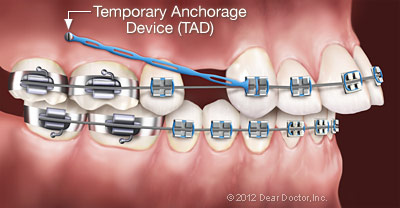
Essentially, TADS are small, screw-like dental implants made of a titanium alloy. As the name implies, they're temporary — they usually remain in place during some months of treatment, and then they are removed. Their function is to provide a stable anchorage — that is, a fixed point around which other things (namely, teeth) can be moved. But why is anchorage so important?
Moving teeth in the jaw has been compared to moving a stick through the sand. With the application of force, sand moves aside in front of the stick, and fills up the space behind. The "sand" in this case consists of bone cells and cells of the periodontal ligament, which attaches the tooth to the bone. These tissues slowly move aside and reform as force is applied to them by orthodontic appliances, such as wires and elastics.
But to do its work, that force needs a fixed point to push against. For example, imagine trying to move the stick while you're floating free in the water: Not so easy! But with two feet firmly planted in the sand, you can do it. When possible, orthodontists use the back teeth as an anchor — but sometimes, cumbersome headgear may be required to provide the necessary anchorage. In many cases, using TADS can change that.
What TADS Can Do
While it's generally preferred, the use of teeth as orthodontic anchors can have drawbacks in some cases. For example, there may not be a viable tooth located at the point where an anchor is needed. Also, when a greater force is required, the teeth used as anchors can themselves start to move. This is one instance where TADS are beneficial: These mini-implants can eliminate the need to use teeth as anchors, or stabilize a tooth that's being used as such.
TADS can also provide an anchorage point for a pushing or pulling force that would otherwise need to be applied from outside the mouth: generally, via orthodontic headgear. Wearing headgear can be uncomfortable, and compliance is sometimes a problem. In many situations TADS can eliminate the need for headgear, a welcome development for many patients.
The use of TADS offers other benefits as well: It may shorten overall treatment time, eliminate the need to wear elastics (rubber bands) — and in some cases, even make certain oral surgeries unnecessary. It also allows orthodontists to take on complex cases, which might formerly have proved very difficult to treat. This small device can really do a big job!
Getting (and Maintaining) TADS
Like dental implants (which have been in use since the 1970s) TADS are small, screw-like devices that are placed into the bone of the jaw. Unlike implants, however, they don't always need to become integrated with the bone itself: They can be fixed in place by mechanical forces alone. Plus, they're much easier to put in and remove when treatment is complete. How easy?
Placing and removing TADS is a minimally-invasive, pain-free procedure. After the area being treated is numbed (with an injection or other numbing treatment), a patient feels only gentle pressure as the device is inserted. The whole process can take just minutes to complete. Afterwards, an over-the-counter pain reliever can be taken if needed — but many patients need no pain reliever at all. And taking TADS out is even easier. So if you're worried that it may be a painful procedure: Relax! It's far less stressful than you may think.
While they're in place, TADS require minimal maintenance. Generally, they should be brushed twice daily with a soft toothbrush dipped in an antimicrobial solution. We will give you specific instructions regarding maintenance when your TADS are placed.
Not every orthodontic patient needs TADS — but for those who do, it's a treatment option that offers some clear benefits.
Related Articles
What are TADS? Anchorage, or resistance to movement, is an important concept in orthodontics. Anchorage in orthodontics is often supplied by a tooth or group of teeth that are supposed to stay still as forces are applied against them in a way that only the mal-positioned teeth will move — into better position. The challenge is to avoid the anchor teeth from moving too. That's where Temporary Anchorage Devices (TADs) come in. TADS are mini-screws or mini-implants temporarily placed into the bone of the jaws to be used as non-mobile anchor units that facilitate tooth movement. TADs can shorten orthodontic treatment time and are e
You probably know that it's never too late to begin orthodontic treatment — but when it comes to your youngster's teeth, did you know that earlier may be better than later? According to the American Association of Orthodontists, kids should have an initial orthodontic screening at age 7. What makes early evaluation — and potentially, early treatment — so important?
There are several ways that kids can benefit from seeing an orthodontist at an early age. But it's important to recognize that early evaluation isn't necessarily followed by early treatment; in most cases, if orthodontic work is needed, we simply monitor your child's growth patterns until we see that it's time for treatment to begin. This gives us an opportunity to get the best results in the most efficient way, and to help prevent future problems.
Although every child's development is different, in most kids the first adult molars have typically started to emerge by around age six. This, along with other developmental markers, lets us get a handle on the basic alignment of the teeth, from front to back and side to side. It may also be possible at this point to determine whether there is adequate room in the mouth for all of the permanent teeth — and, if not, to take action.
When Earlier Treatment Is Better
Treatment for common orthodontic problems typically begins around age 9-14, when all of the baby teeth are gone and many of the permanent ones are in place. But there are some conditions that are much easier to treat if they're caught at an early age, when a child's natural growth processes are going full speed ahead.
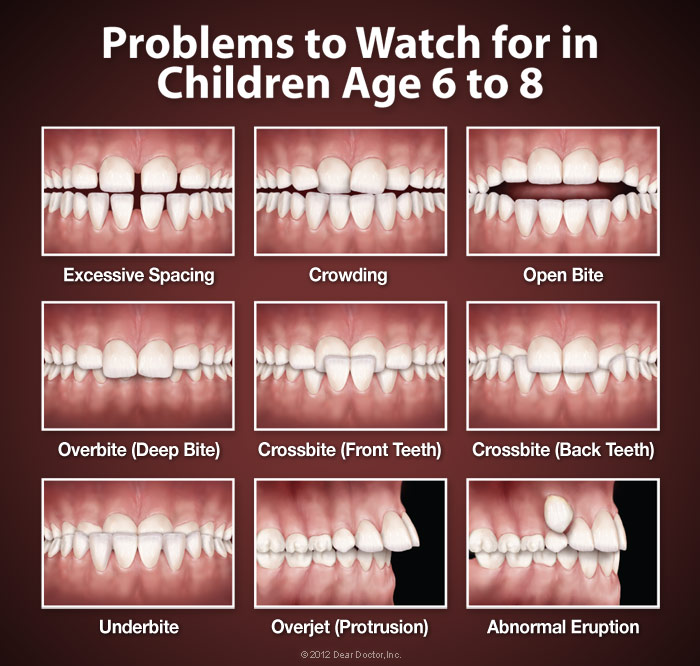
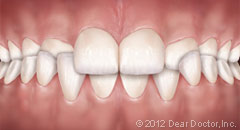 One is severe crossbite, a condition where the upper teeth close inside the lower teeth. To treat this problem, a device called a palatal expander can be used, which gradually and painlessly widens the upper jaw; it's especially effective when the jaw itself hasn't fully developed. If we wait too long, a more complicated treatment — or even oral surgery — might be required to correct the problem.
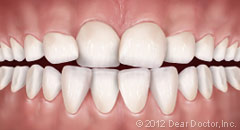 Another condition that may benefit from early treatment is severe crowding. This occurs when the jaws are too small to accommodate all of the permanent teeth. Either palatal expansion or tooth extraction may be recommended at this point, to help the adult teeth erupt (emerge from below the gums) properly. Even if braces are required later, the treatment time will likely be shorter and less complicated.
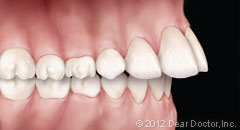 Early intervention may also be helpful in resolving several other problems. Protruding teeth, especially in front, can be prone to chipping and fractures; they may also lead to problems with a child's self-image. A severe underbite, caused by the lower jaw growing much larger than the upper jaw, can result in serious bite problems. Orthodontic appliances, including braces and headgear, can be successfully used to correct these problems at this stage, when the child's development is in full swing, thereby increasing the chances that surgery can be avoided.
Correcting Bad Habits
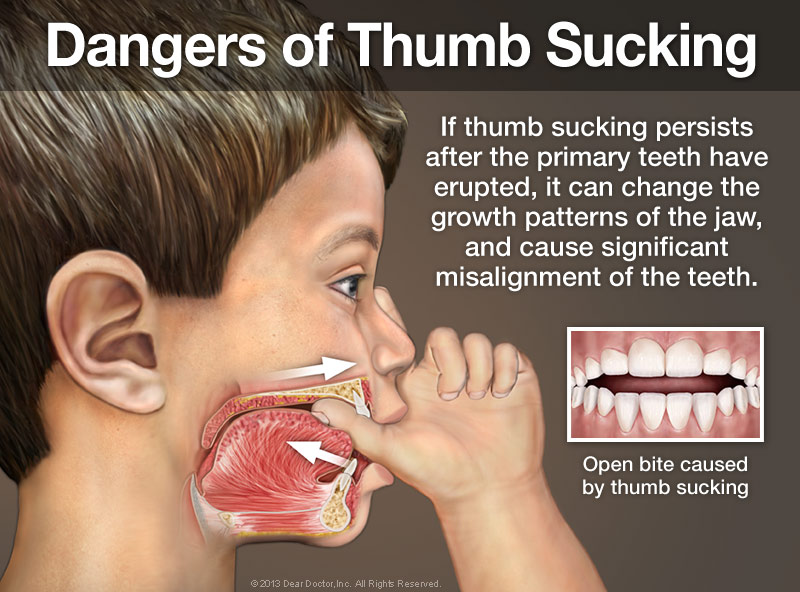
At one time or another, anyone may pick up a bad habit. But there are some situations where a youngster's parafunctional (detrimental to health) habits can actually influence the development and function of his or her teeth, jaws and mouth. Some examples of these are persistent thumb sucking, tongue thrusting and mouth breathing.
The sucking reflex is natural in early childhood; it usually disappears between ages 2 and 4. But if it persists much later, the pressure of the digit on the front teeth and the upper jaw can actually cause the teeth to move apart and the jaws to change shape. This can lead to the orthodontic problem called "open bite," and may impair speech. An open bite can also be caused by the force of the tongue pushing forward against the teeth (tongue thrusting).
Mouth breathing — an abnormal breathing pattern in which the mouth always remains open, passing air directly to the lungs — is related to alterations in the muscular function of the tongue and face. It may cause the upper and lower jaw to grow abnormally, which can lead to serious orthodontic problems. Although mouth breathing may start from a physical difficulty, it can become a habitual action that's hard to break.
Various orthodontic treatments are available to help correct these parafunctional habits — and the sooner they're taken care of, the less damage they may cause. But these potential problems aren't always easy to recognize. That's one more reason why you should bring your child in for an early orthodontic screening.
Related Articles
Early Orthodontic Evaluation Early detection of orthodontic problems in young children may make it easier to correct those problems in the long run. Waiting until all of the permanent (adult) teeth have come in, or until facial growth is nearly complete, may make correction of some problems more difficult or even impossible. An early childhood orthodontic evaluation can yield excellent results... Read Article
How Thumb Sucking Affects The Bite Thumb sucking can actually block the front teeth from erupting fully and can also push the teeth forward — sometimes more on the side where the thumb rested. How far out of position the teeth end up will depend on the number of hours per day the thumb was in the child's mouth and how much pressure was applied. When the pressure exerted by the thumb in the mouth is particularly strong and occurs over a long period of time, the forces can potentially influence growth of the jaws... Read Article
The Magic of Orthodontics Proper alignment of the teeth is basic to "Smile Design." Their position dictates how they work together and affects the way you look and smile. Only orthodontic treatment can move teeth into the right position. Simply put, when things look right, they probably are right. Learn the basics of smile analysis and design and whether the magic of orthodontics will work for you... Read Article